
What Startupfest 2026 Reminded Me About Building Great Companies | July 2026
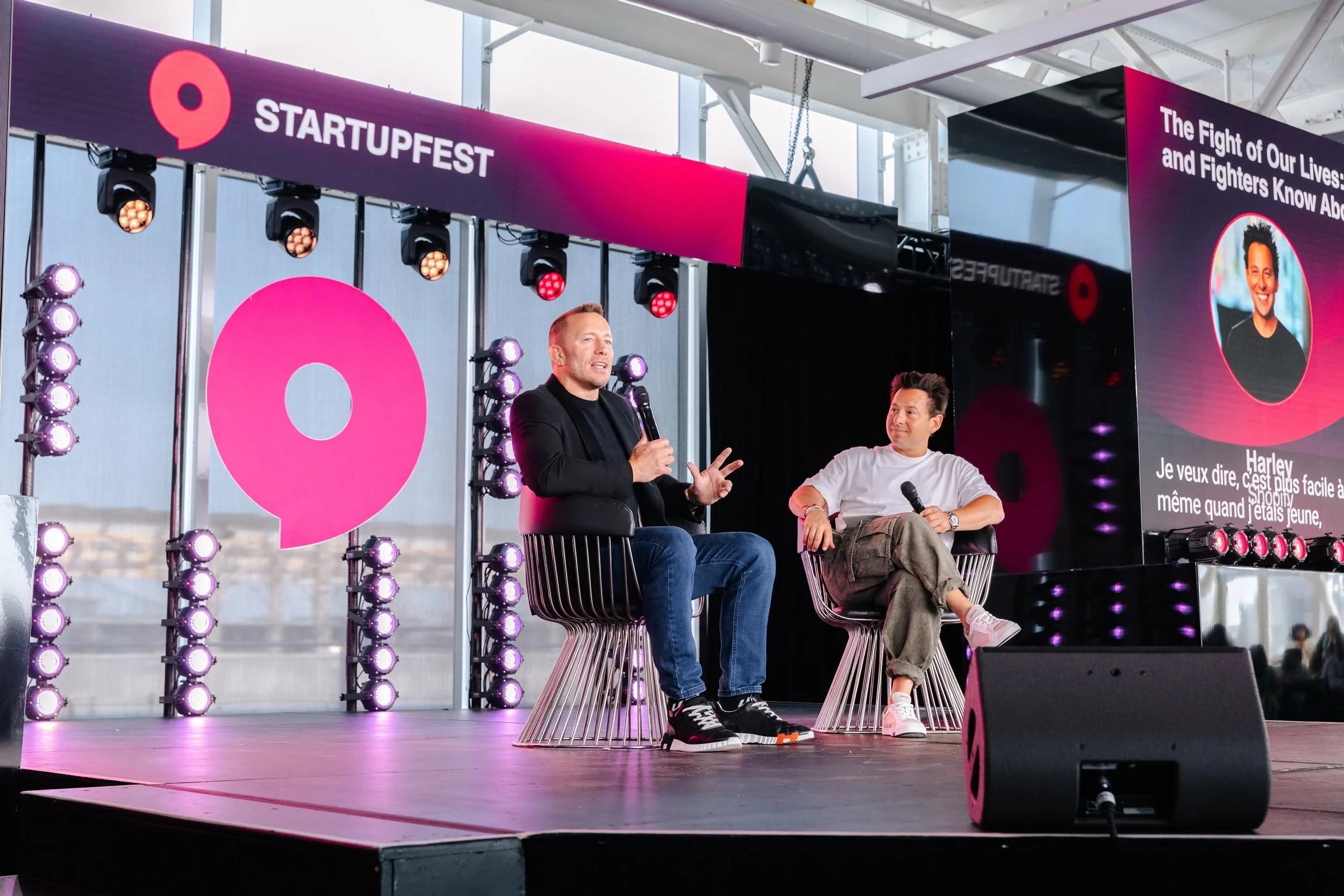
Twenty Years Building Ari Agency Taught Me That Every Company Is a Reflection of Its Founder.
Congratulations to Startupfest on celebrating its Sweet Sixteen.
For 16 years, Startupfest has brought together founders, investors and innovators who believe there is always a better way to build something meaningful. I arrived expecting to hear about AI, fundraising, scaling businesses and the future of entrepreneurship.
I left thinking about something entirely different.
I left thinking about myself.
Not in an egotistical way.
In a reflective way.
Sometimes the best conferences don't teach you something new. They remind you of something you've been slowly learning your entire life.
That was Startupfest for me.
The catalyst was an on-stage conversation between Harley Finkelstein and Georges St-Pierre.
Harley shared something that immediately caught my attention.
Despite helping build one of Canada's greatest entrepreneurial success stories, he admitted that he still gets incredibly nervous in the moments before Shopify's live quarterly earnings calls. That anxiety, he explained, is what drives him to prepare harder than anyone else.
Georges smiled. He understood exactly what Harley meant.
Before every championship fight, despite years of success and title defences, he felt the same fear.
Then he said something that stopped me.
"There's no courage without fear"
He wasn't trying to eliminate fear.
He was preparing so well that fear no longer controlled him.
I found myself sitting there thinking...
I always assumed successful people eventually outgrew fear.
Apparently they don't.
The arena simply gets bigger.
That conversation took me back more than 20 years.
Long before Ari Agency.
Long before executive search.
Long before A-WAY.
Back to a young entrepreneur who desperately wanted to prove that his ideas could become reality.
Looking back, I definitely had a chip on my shoulder.
Not because I wanted to beat someone else. Because I wanted to prove something to myself.
Like many founders, I believed hard work could solve almost anything.
Sometimes it did. Sometimes it didn't.
My first business started while I was still in university.
I sold toilet paper door-to-door.
Yes...
Toilet paper.
Long before Costco convinced us we needed enough toilet paper to survive the apocalypse, I was ringing doorbells asking complete strangers if they'd like to buy some.
If you've ever tried selling toilet paper to someone who wasn't planning on buying toilet paper that day...
You'll quickly discover it isn't about the product.
It's about the conversation.
Every "no" taught me something.
Every rejection made the next conversation easier.
At the time I thought I was learning sales.
Looking back...
I was learning resilience.
Not every lesson came from success. Some came from walking away.
At one point I became involved in selling gemstones through what I believed was a legitimate business opportunity.
The people around me were exceptional salespeople.
They could sell almost anything.
The problem was...
I slowly realized I no longer believed in what we were selling.
Walking away cost me money.
But it taught me one of the most important lessons of my career.
If your values and your business start moving in opposite directions...
Eventually one of them has to give.
Looking back, that experience shaped almost every important business decision I've made since.
Trust starts with believing in what you're asking someone else to believe.
Ironically, I found myself entering financial services.
I earned my securities licence and joined RBC Dominion Securities.
I was supposed to become a financial advisor.
Instead, I became fascinated with marketing.
I created one of the first client newsletters for the Vice President I worked with.
Looking back now, the clues were everywhere.
I kept finding myself drawn toward ideas, communication and entrepreneurship.
I just hadn't admitted it yet.
Eventually I left to build another business, creating cooperative advertising programs where multiple companies shared the cost of premium advertising placements.
I loved bringing people together.
I loved building something from nothing.
I loved solving problems.
But there was something else happening beneath the surface that few people knew.
School had never come easily for me.
Years later I was diagnosed with ADHD.
Suddenly, so many things made sense.
Why focusing had always been difficult.
Why I failed courses before eventually graduating.
Why my mind constantly jumped from one idea to another.
Throughout different periods of my career, I also dealt with anxiety and depression.
For years, I battled stage fright.
It's funny now.
People who know me today assume public speaking comes naturally.
It doesn't.
So I decided to confront it.
I joined an improv group.
Later I performed in a fourteen-show stage production.
For a while, I genuinely thought acting might become my career.
It didn't.
More recently, I joined a band.
Not because I plan on becoming a musician.
Because I've learned something about myself.
Growth rarely happens inside your comfort zone.
Every meaningful chapter of my life has started with discomfort.
Then came the moment that changed everything.
I had moved from Montreal to Toronto and was building a career in the digital agency world.
I landed what I thought was my next big opportunity.
Three months later...
I was fired.
It was devastating.
I had just bought an engagement ring.
I was getting married that summer.
My severance barely gave me time to think.
For a few days I questioned everything.
Then something unexpected happened.
I stopped asking myself where I should work.
I started asking myself what kind of life I actually wanted to build.
Looking back, getting fired may have been the best thing that ever happened to me.
It forced me back toward something I had always loved.
Building businesses.
My parents used to joke...
"Drop Ari anywhere in the world with a telephone and he'll figure it out."
At the time, I thought they were talking about resourcefulness.
Looking back...
They were describing entrepreneurship.
One client became two.
Two became ten.
Slowly...
Ari Agency was born.
I didn't set out to build a recruiting company. In fact, I often joke that my mother was the recruiter in the family.
I simply wanted to help people make better career decisions.
I thought I might even become a career coach.
The more conversations I had, the more I realized something.
What fascinated me wasn't resumes.
It wasn't job descriptions.
It wasn't recruiting.
It was people.
I loved understanding what made founders tick.
What drove them.
What they feared.
What they couldn't see about themselves.
And that realization would eventually change everything.
One of the biggest misconceptions about entrepreneurship is that great founders build great companies.
I don't believe that's true anymore.
I think self-aware founders build great companies.
There's a difference.
For years I believed my job was to solve every problem.
Sales.
Marketing.
Operations.
Finance.
Recruitment.
Business development.
Client relationships.
If something needed to get done, I assumed I was the best person to do it.
That mindset helped me build Ari Agency.
Ironically...
It also prevented it from growing.
At some point every founder becomes the bottleneck.
Not because they aren't capable.
Because they refuse to admit they can't possibly be exceptional at everything.
That realization took me much longer than it should have.
Today I see it differently.
My strengths are someone else's weaknesses.
My weaknesses are someone else's strengths.
The faster you recognize that...
The faster your company begins to scale.
One of the comments that stayed with me came from Georges St-Pierre.
He wasn't talking about fighting.
He was talking about building his team after his fighting career.
He explained that every important decision came down to two questions.
Can I trust this person?
Are they competent enough to do the job?
Miss one...
Eventually you'll pay for it.
I've seen exactly the same thing over the past twenty years.
Sometimes founders hire people they genuinely like and trust.
Unfortunately, they aren't capable of taking the business where it needs to go.
Other times they hire incredibly talented executives with impressive résumés.
But the trust never develops.
Neither relationship lasts.
Trust without competence doesn't scale.
Competence without trust doesn't last.
The best leadership teams require both.
Harley shared another story that reinforced this point.
He spoke about Drake and the CEOs running many of his businesses.
What surprised him wasn't that many of them had known Drake since childhood.
It was that every one of them satisfied the same two requirements Georges had just described.
Trust.
Competence.
Not one or the other.
Both.
It reminded me how often founders ask the wrong question.
"Where do I find great people?"
The better question is...
"How do I recognize them?"
That thought stayed with me as I listened to Becky Wang.
She said something that immediately found its way into my notebook.
"Extraordinary companies aren't built by one brilliant founder. They're built because a handful of people picked each other very well."
I've thought about that sentence almost every day since.
After twenty years in executive search, I've become convinced she's right.
People often assume our job is finding exceptional executives.
It isn't.
Our job is helping founders build exceptional leadership teams.
Those are two very different things.
I've seen brilliant executives fail because they joined the wrong founder.
I've seen average-looking candidates become extraordinary because the environment allowed them to thrive.
Leadership isn't built in isolation.
It's built in relationships.
Ron J. Williams took that idea one step further.
His presentation focused on trust.
Not as a personal value.
As a competitive advantage.
That distinction really resonated with me.
Trust isn't soft.
Trust accelerates decision making.
Trust reduces friction.
Trust creates speed.
Trust gives people permission to challenge one another without questioning intent.
The longer I've been in business, the more I've realized every meaningful relationship begins with trust.
Clients trust us with one of the most important decisions they'll ever make.
Candidates trust us with their careers.
Founders trust us with their businesses.
Without trust...
Nothing else matters.
One story Georges shared has stayed with me more than any lesson about championships or competition.
Years after becoming one of the greatest fighters in history, he unexpectedly ran into the boy who used to bully him in school.
The man was standing on a street corner asking strangers for money.
Georges recognized him immediately.
He could have ignored him.
He could have embarrassed him.
Instead...
He walked over.
Spoke to him.
Encouraged him.
Gave him money.
Told him he was capable of more.
Weeks later, the man tracked down Georges' parents to thank him.
That story had nothing to do with fighting.
It had everything to do with character.
Earlier in the conversation Georges explained that, years before, his father had taken him to the bully's home after discovering what was happening.
What he found changed everything.
The boy who bullied Georges was himself growing up in an abusive home.
Georges realized he had never really been the target.
He had simply become the closest outlet for someone else's pain.
Leadership often asks us to do exactly that.
Look beyond behaviour.
Understand the person.
Lead with empathy before judgement.
I don't know if enough people noticed it.
But for me...
That may have been the most important leadership lesson shared all day.
Another speaker, Sam Colby, challenged founders with a deceptively simple question.
Stop asking...
"Who should I hire?"
Instead ask...
"What problem am I actually trying to solve?"
It sounds obvious.
Yet so many companies get this wrong.
They finally raise capital.
They have budget.
Their instinct is to hire.
But hiring isn't a strategy.
Sometimes better systems solve the problem.
Sometimes AI helps.
Sometimes a fractional executive is exactly what's needed.
Sometimes the founder hasn't actually identified the real issue yet.
That resonated deeply because it's exactly why our work begins long before candidate outreach.
The search starts by understanding the founder.
The business.
The leadership team.
The culture.
The blind spots.
Only then does the hiring begin.
I've learned over the years that most hiring mistakes aren't candidate mistakes.
They're diagnosis mistakes.
We're solving the wrong problem.
And when that happens...
Even the best executive in the world struggles to succeed.
One of the advantages of spending two decades sitting across the table from founders is that patterns eventually begin to emerge.
The founders who build remarkable companies aren't always the smartest people in the room.
They aren't always the loudest.
They aren't always the most charismatic.
They're usually the most curious.
They're willing to challenge their own assumptions.
They're comfortable admitting what they don't know.
They're willing to ask for help.
Most importantly...
They know where they create value.
And where someone else can create even more.
That kind of self-awareness is surprisingly rare.
But when you find it...
Everything changes.
The Last Reflection
As I drove home from Startupfest, I realized something.
None of the speakers had fundamentally changed how I think.
They simply gave words to lessons I'd been slowly learning over the last twenty years.
Harley reminded me that fear never disappears.
Preparation simply gives us permission to move through it.
Georges reminded me that greatness has very little to do with talent.
It has everything to do with discipline, humility and the people you surround yourself with.
Becky reminded me that extraordinary companies aren't built by extraordinary individuals.
They're built by people who choose each other well.
Ron reminded me that trust isn't a soft skill.
It's one of the most valuable assets a company can ever build.
Sam reminded me that great hiring doesn't begin with candidates.
It begins with understanding the problem.
As I listened to each of them...
I realized they were all talking about the same thing.
Self-awareness.
The founder who understands themselves almost always builds a better company.
Because founders don't just build businesses.
They build cultures.
They build leadership teams.
They build decision-making patterns.
They build trust.
And whether they realize it or not...
They build hiring patterns.
Over the last twenty years I've had the privilege of interviewing thousands of executives and sitting across the table from hundreds of founders.
Eventually patterns begin to emerge.
The way founders interview.
The way they evaluate people.
The way they communicate.
The people they naturally gravitate toward.
The blind spots they consistently miss.
The strengths they unintentionally overvalue.
I believe those patterns exist long before a résumé ever arrives.
I've started calling them Hiring Patterns.
And I believe understanding them before making an executive hire may become one of the greatest competitive advantages any founder can develop.
Because hiring isn't really about people.
It's about decisions.
And every hiring decision begins with the founder making it.
Which is why I've come to believe something that sits at the heart of Ari Agency.
Every company is a reflection of its founder.
Every strength.
Every fear.
Every blind spot.
Every value.
Every decision.
Every hire.
Years ago, I thought entrepreneurship was about proving myself.
Today...
I think it's about understanding myself.
Because every time a founder grows...
Their company grows with them.
That's why I still love this work after 20 years..
It's never really been about recruitment.
It's about helping founders see what they couldn't see before.
Those moments when someone stops, looks across the table and says...
"I've never thought about it that way."
Those are still my biggest wins.
Not the largest search.
Not the biggest client.
Not the highest fee.
Those conversations.
Those breakthroughs.
Startupfest reminded me of something I hope I never forget.
Technology will continue to transform how we build companies.
AI will reshape jobs.
Markets will change.
Business models will evolve.
But one thing won't.
Great companies will always be built by great people.
People willing to challenge themselves.
People willing to learn.
People willing to trust.
People willing to build others before themselves.
And maybe...
That's what entrepreneurship has really been teaching me all along.
Building Ari Agency was never the biggest project of my life.
Building myself was.
