
Would You Have Hired Elizabeth Holmes? | Sept 2026
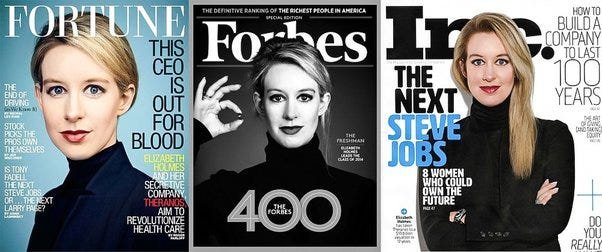
Elizabeth Anne Holmes is an American businesswoman convicted of fraud in connection with her health technology company Theranos.
On the weekend, a friend showed me the trailer for the new Elizabeth Holmes documentary, and it immediately got me thinking about hiring.
Not because I think we’re all out there interviewing the next Elizabeth Holmes. Thankfully. But watching her speak, I was reminded just how powerful confidence, charisma and a compelling story can be.
We’ve all experienced it. Someone walks into the room and, within minutes, we’re impressed. They have the presence, the pedigree and all the right answers. And before we know it, we’ve started filling in the blanks ourselves.
That’s what made me want to revisit the Theranos story, because beneath everything that happened is a fascinating question about human judgment: How did so many smart, experienced people become so convinced?
And perhaps more importantly for those of us making critical hiring decisions: How do we protect ourselves from those same vulnerable moments when our instincts, assumptions and first impressions start getting ahead of the evidence?
When the signals become the story
Let’s go back to 2014.
A company called Theranos looked like the future.
Over the course of its history, the company raised roughly $1.3 billion and was valued at around $9 billion. Its founder, Elizabeth Holmes, was young, confident and extraordinarily persuasive. She had attracted prominent investors, assembled an impressive board and built a compelling vision around seemingly revolutionary technology.
The promise was simple: a single drop of blood could be used to run hundreds of different tests. The technology, however, didn’t work as promised. Holmes was ultimately convicted of defrauding investors and sentenced to more than 11 years in prison.
But here’s the part that is worth thinking about. How did so many smart people miss the basics and trust her?
It wasn’t necessarily because they lacked intelligence or expertise. They were influenced by the signals surrounding the story.
The confidence.
The credentials.
The charisma.
The vision.
And somewhere along the way, their own judgment was replaced by the perception they had formed of the person in front of them.
This happens in hiring, too.
Not usually in such dramatic fashion, of course. But we see a version of it all the time.
A candidate has worked at an impressive company. They have a big title. They speak confidently. They interview beautifully. They have an impressive network. They tell a compelling story about their career. And suddenly, we’re doing something dangerous:
We’re filling in the blanks ourselves.
We assume the big company means they’re capable.
We assume the title means they’re a strong leader.
We assume confidence means competence.
We assume a polished answer means strategic thinking.
But those things are signals. They’re not proof.
A great resume can tell you where someone has been. It doesn’t necessarily tell you how they think. A big title can tell you what someone was called. It doesn’t tell you how they actually led. A polished interview can tell you someone knows how to interview. It doesn’t necessarily tell you how they’ll perform when the stakes are high, the information is incomplete and the answer isn’t obvious.
That’s where critical thinking matters.
Being impressed isn't the same as understanding. Critical thinking isn’t about being cynical or assuming everyone is hiding something. It’s about being willing to pause when something looks impressive and ask:
What do we actually know?
What is the evidence?
What questions haven’t we asked?
What assumptions are we making?
Can they explain their reasoning, not just their results?
Can we validate the impact they’ve had?
Are we responding to demonstrated capability, or to confidence, pedigree, charisma and a great story?
That’s the difference between being impressed by a candidate and actually understanding a candidate. And that distinction matters. Because the real hiring skill isn’t just assessment. It’s judgment.
It’s being disciplined enough to separate what we feel about a candidate from what we actually know about them.
A charismatic candidate can still be exceptional.
A quiet candidate can still be exceptional.
An impressive pedigree can be meaningful.
And an unconventional career path can still produce an exceptional leader.
The point isn’t to ignore the signals.
It’s to make sure the signals don’t become the evidence.
Trust your gut. Then test it.
Our job isn’t to eliminate intuition. I actually believe intuition matters enormously in hiring. Our job is to challenge it.
To slow down the moment when everyone says, “I love this candidate,” and ask why. What evidence supports that feeling? What haven’t we validated? What might we be assuming? Are we seeing the candidate clearly, or are we filling in the gaps with our own expectations?
That’s why we spend so much time upfront understanding what success actually requires, gathering different stakeholder perspectives and identifying the assumptions and biases that can quietly influence a hiring decision.
At Ari Agency, we believe executive search should go deeper than matching a resume to a job description.
We want to understand the person behind the career history: how they think, how they make decisions, how they’ve handled complexity, how they’ve led through difficult moments and what they’ve actually delivered.
Because ultimately, hiring isn’t about finding the person who looks most impressive on paper.
It’s about gathering enough evidence to know they’re right for the role.
Better hiring judgment doesn’t come from ignoring your gut. It comes from knowing when your gut needs evidence.
